Ivana Gavrić, solo piano
on 2 May 2025
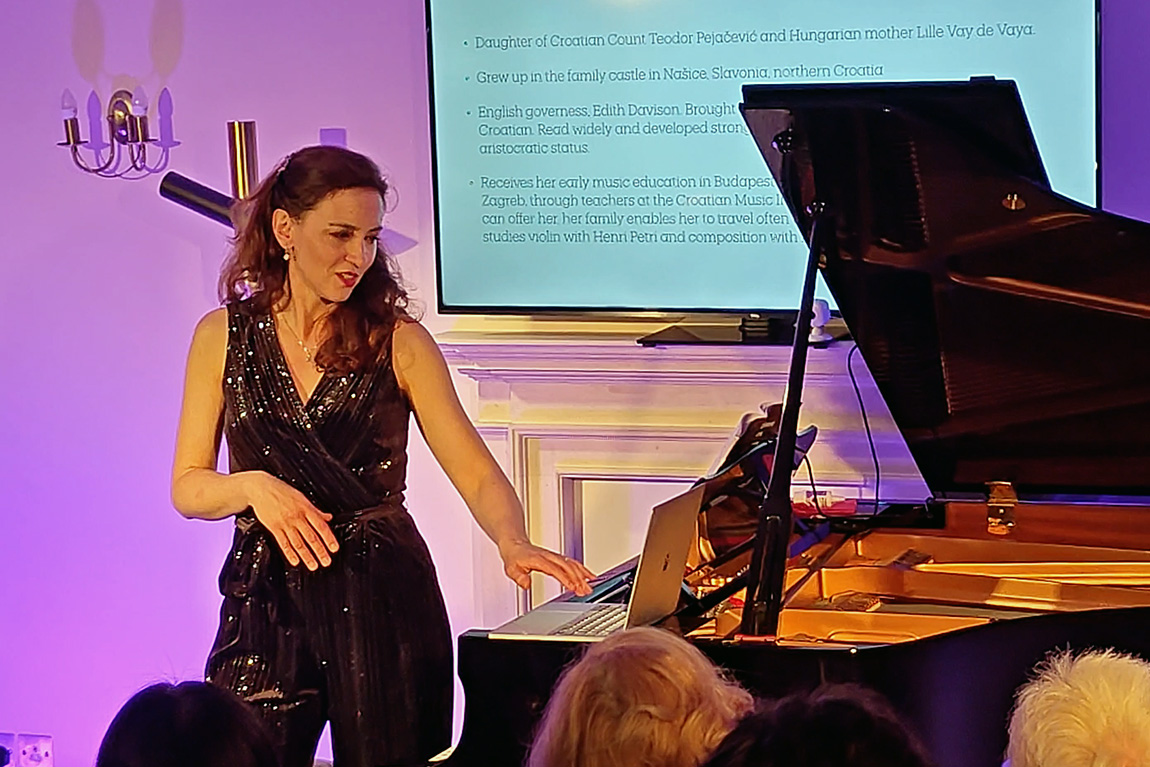
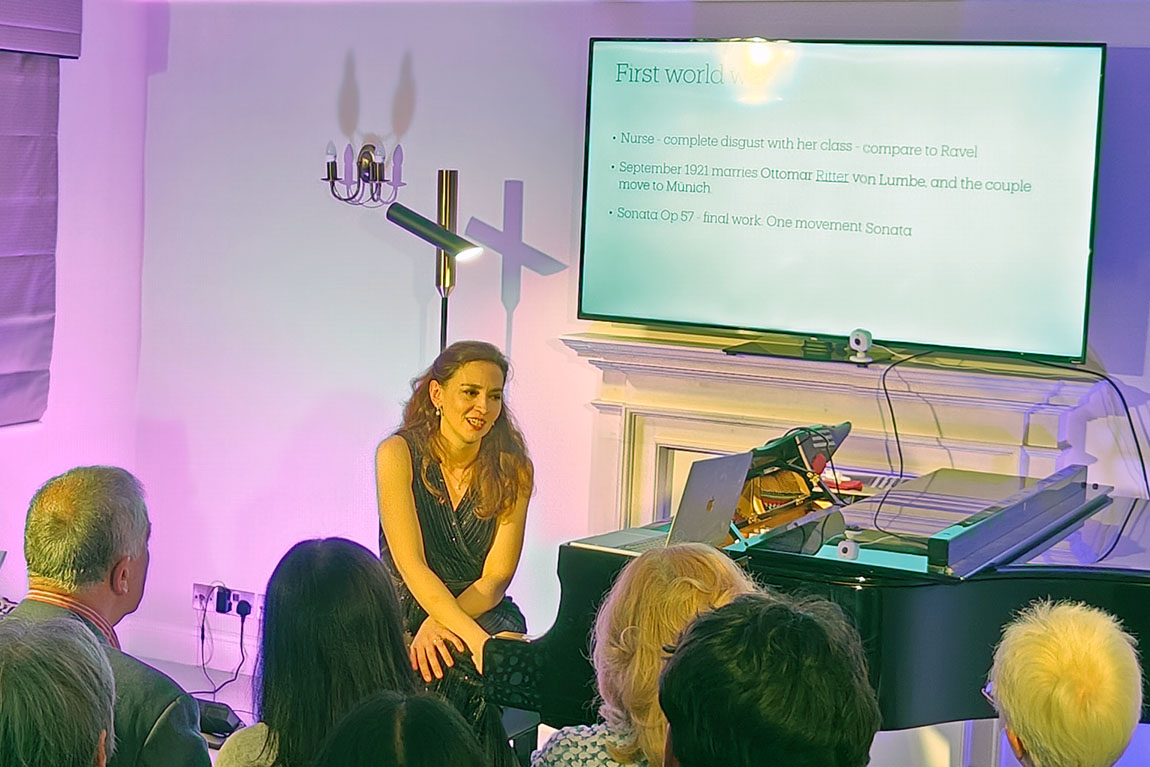
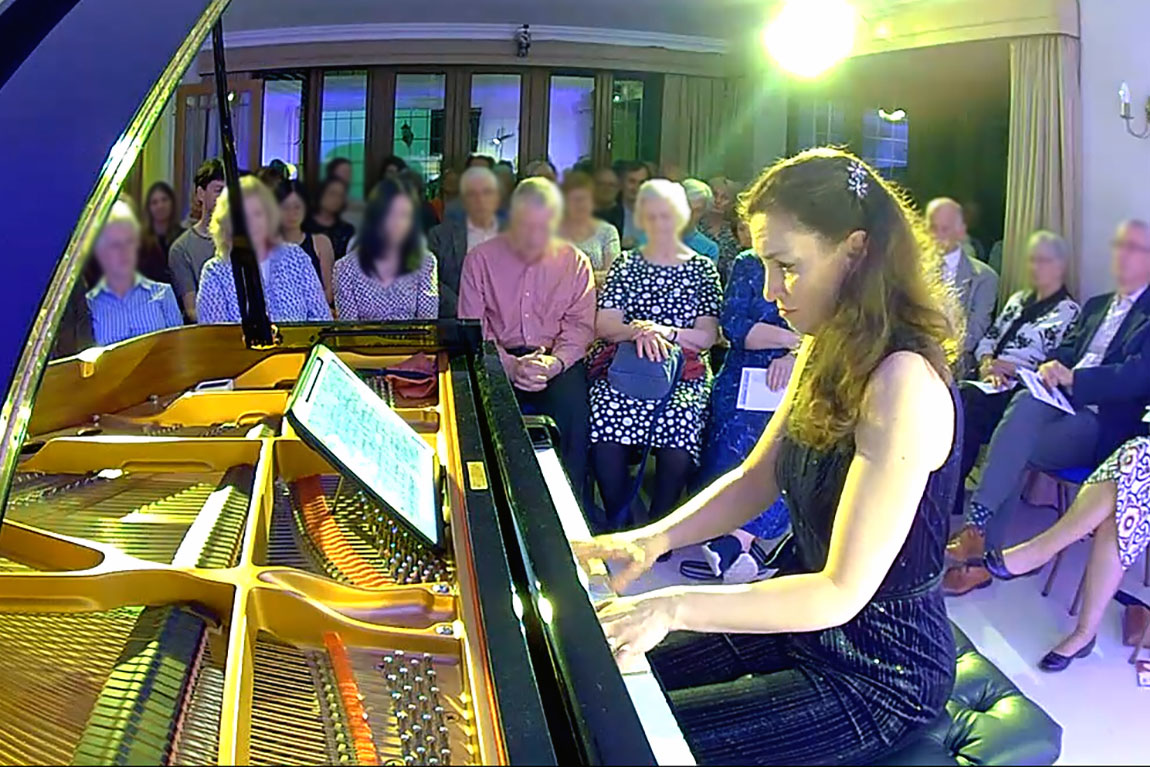
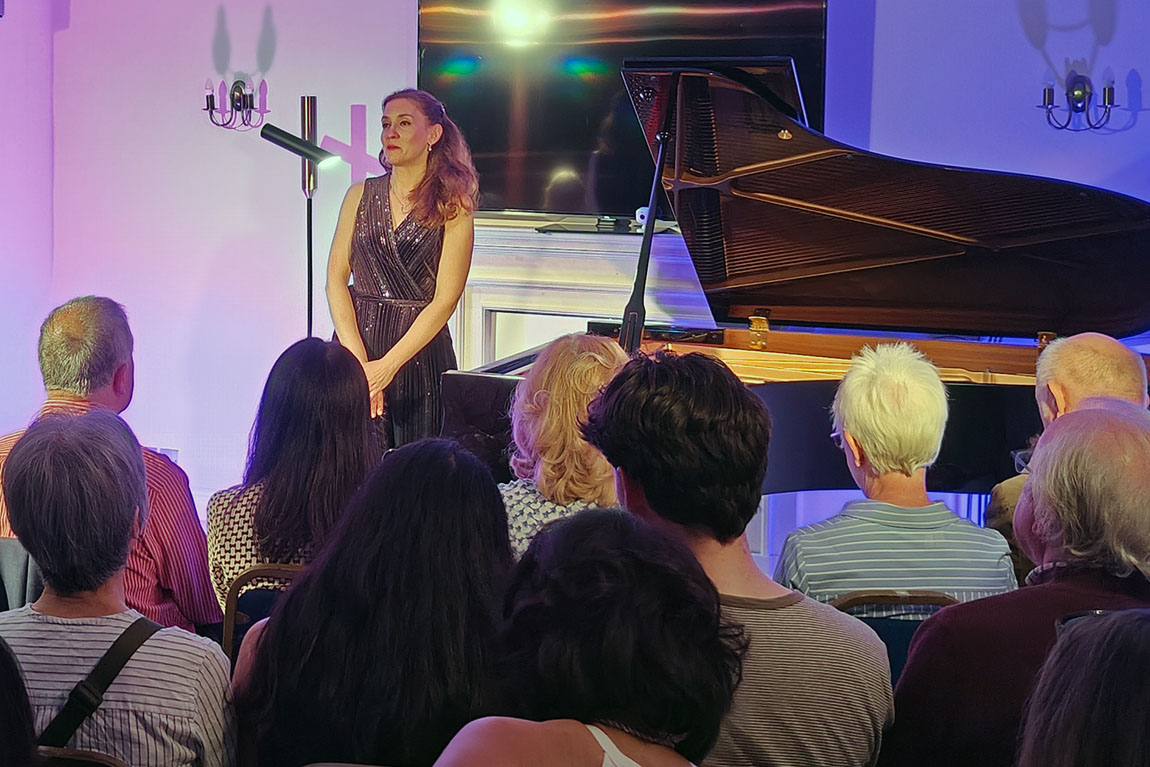

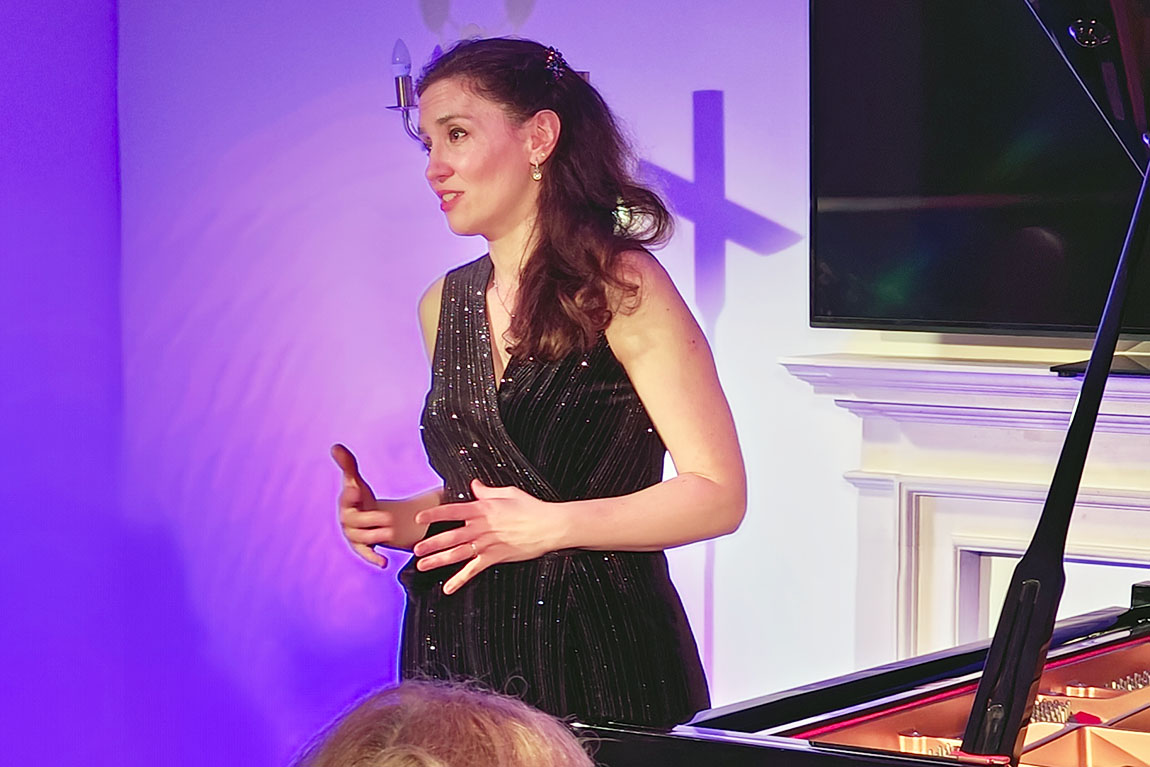
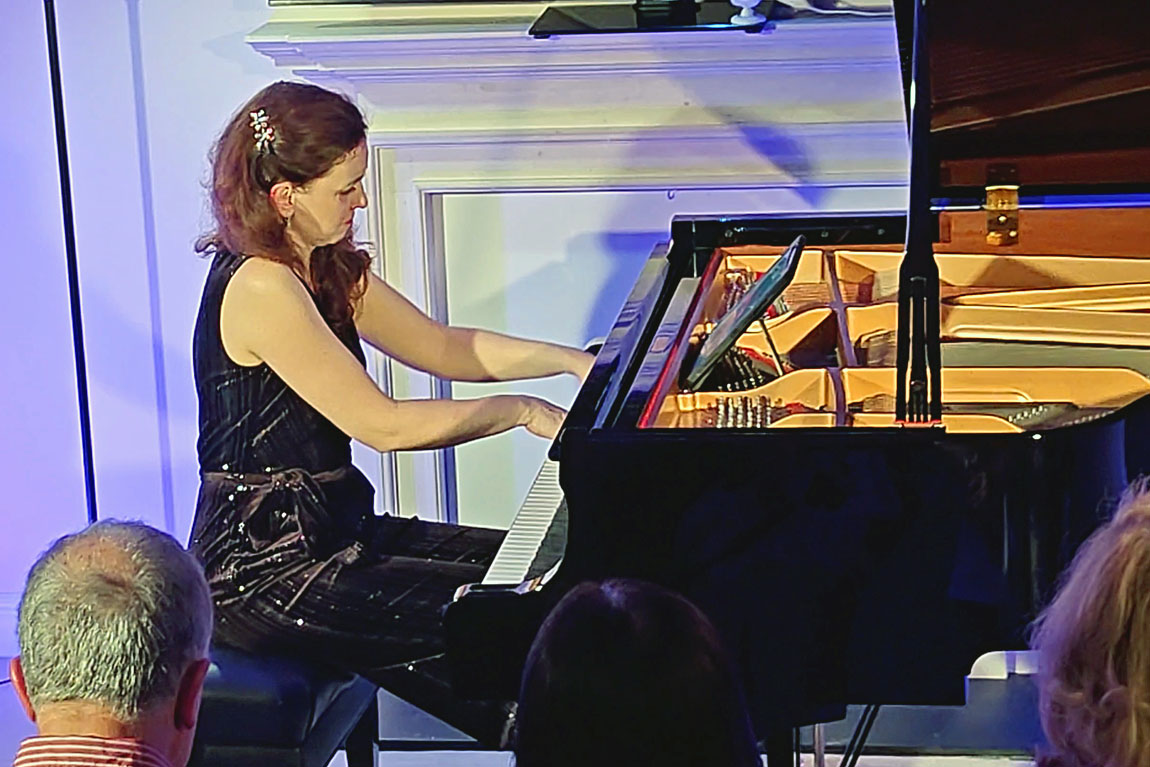
As soon as Ivana Gavrić hit the first note of Berceuse, which Dora Pejačević composed when she was only 12 years old, and then proceeded onto the sweet melody in a gentle rocking motion that followed, its lyrical charm spread sweetly, and we felt totally comfortable and ready to be guided by her expert hands. For the next hour, we were taken on a quick yet memorable journey of the Croatian composer’s tragically short life and work in chronological order.
During the middle period of Pejačević ’s composition life, her works developed with harmonious and tonal beauty (sometimes you’d be surprised by an unpredictable encounter; “Listen to the 3rd note of The Rose”, Ivana suggested). For this period Ivana selected The Rose, The Red Carnation, Lilies, and Chrysanthemum from Blemenleben (The Life of Flowers) Op. 19. These lyrical poetic miniatures were not merely sweet; Ivana’s expressive playing portraited the vivid characteristics of each flower.
World War I impacted and changed many people’s lives, and Dora Pejačević wasn’t an exception. Ivana explained that she volunteered as a nurse and paramedic – the experience deeply impacted her and influenced her compositions. In the last period of her life, Pejačević ’s compositions became more structured, and harmony and tones further developed. After performing the introspective and rather private Two Nocturnes Op. 50, Ivana proceeded to the Piano Sonata, one of the composer’s final works. This tightly packed one-movement Sonata was punchy, energetic and rhythmical and was presented by Ivana in the most effective manner. It made a huge contrast to the previous pieces which added extra attraction to the first half.
Proceeding onto the second half, Ivana performed Autrefois and Norvegienne from Humoristiques Op. 87 by Cécile Chaminade, another female composer from the similar generation of Pejačević ’s and also from an aristocratic background. Ivana’s communicative playing conveyed two very contrasting charms to the audience.
Ravel’s Le Tombeau de Couperin, bearing a sense of memorial, dedicating each movement to a friend lost in the First World War, concluded the recital. Another composer deeply affected by the war, who, like Pejačević,, volunteered during the war. With this Ivana gathered many strands already present in the programme: memory, transformation, elegance, tonal and harmonious beauty, and mighty technical difficulties and delivered a stunning ending.
Returning to Pejacevic, Ivana performed Remembrance Op. 24 as an encore. Delicate, moving and truly beautiful.
It was a privilege to learn about the composer Dora Pejačević ’s dramatically evolving compositions during her short life. We also appreciated Ivana’s thoughtful programming – Dora Pejačević, Cécil Chaminade and Maurice Ravel, composers who are connected in some way or another.
Ivana Gavrić has attracted international acclaim for her interpretations of a broad range of repertoire and storytelling programming, her playing described as ‘electrifying’ (BBC) and ‘impressive, insightful…ravishing’ (Washington Post).
Ivana is drawn to composers like Janáček, Grieg and Chopin, who each take features of their respective homelands to create a distinctive musical voice, whether from the landscape and nature or from elements of folk music and dance.
A long-standing collaboration with the award-winning composer, Cheryl Frances-Hoad, has led to solo works and more recently a concerto, entitled Between the Skies, the River and the Hills, written for Ivana. Ivana is also committed to performing works by female composers of the past, particularly Dora Pejačević, with whom she shares her origins.
Equally at home with core repertoire, Ivana’s recent concerto performances include Grieg and Rachmaninov with the Philharmonia Orchestra at the Royal Festival Hall, and Beethoven’s Emperor with the RPO at the Royal Albert Hall. She has also performed with the Royal Stockholm Philharmonic, South Denmark Philharmonic and Southbank Sinfonia, and has collaborated with conductors including Rafael Payare, Nicholas Collon, Christian Kluxen, Karin Hendrickson and Ben Gernon. She especially enjoys working with chamber orchestras, and highlights to date have included performing with the Trondheim Soloists, Aurora Orchestra, Camerata Zürich and City of London Sinfonia.
Ivana has been heard on the concert platform at Wigmore Hall, the Barbican, the Berlin Konzerthaus, Tonhalle Zürich, KKL Lucerne and the Gilmore Piano Festival, as well as across China, in Canada and recently in Peru. She created a sensation with her debut album In the Mists, winning BBC Music Magazine Newcomer of the Year, her playing hailed as ‘altogether of an extraordinary calibre’ (BBC Music Magazine). Her recording of Grieg: Piano Works was selected as Gramophone Editor’s Choice and the Grieg Society’s Recording of the Year, while her Chopin disc was chosen as Classic FM’s CD of the week.
A dedicated chamber musician, Ivana has recently formed a two-piano duo with Tim Horton, with programmes centred around the Shostakovich anniversary as well as Stravinsky’s The Rite of Spring. She has also partnered colleagues including Maxim Vengerov, Matthew Barley and Thomas Gould at festivals such as Dartington and Presteigne in the UK and Davos in Switzerland. Ivana has taken part in the IMS Prussia Cove Open Chamber Music Sessions and she is an alumna of the Britten-Pears Young Artist Programme as well as Live Music Now. Outside the concert hall, Ivana is featured playing Chopin and Beethoven in BBC2’s adaptation of The Line of Beauty, and Bach in Anthony Minghella’s film Breaking and Entering.
Born into a musical family in Sarajevo and raised in the UK, Ivana studied at the University of Cambridge and at the Royal College of Music. Her teachers include Niel Immelman, Peter Bithell and James Gibb. Ivana is indebted to the support of many trusts, including the hibou Stiftung, Frankopan Fund (Sainsbury Family Charitable Trusts), the MBF, The Solti Foundation, The Nicholas Boas Trust, The Richard Carne Trust and the RVW Trust. Ivana is proud to be an ambassador for the charity ‘Music Action International’. Following three years of giving masterclasses to postgraduate students at Dartington Summer Festival and School, Ivana now works as a Visiting Lecturer at the London College of Music, University of West London.
Ivana’s new album, ‘Throwback to Dance’, exploring Grieg’s influence on Ravel, was released on Signum Classics in November 2025.
Dora Pejačević’s music stands at the centre of this programme not simply because three of the works are hers, but because they reveal, in miniature and in large form, the range of her imagination. Born into an aristocratic Croatian family in 1885, she grew up in a cultivated environment and moved from early salon-inflected piano writing toward a more searching late-Romantic and early modern language. This recital allows that journey to be heard in concentrated form: from the flower pieces of 1904–05 to the inward Nocturnes and the bold, one-movement Sonata of 1921.
The three pieces from Blumenleben, Op. 19 come from a cycle of eight programmatic piano miniatures composed in 1904–05. The title may be translated as “The Life of Flowers”, and the set traces a sequence of flowers across the year. Pejačević does not merely illustrate flowers decoratively. Rather, each piece suggests a mood, a texture and perhaps a symbolic world. In The Rose one hears warmth and lyrical generosity; in The Red Carnation, something more vivid and immediate; in Lilies, a stiller and more contemplative atmosphere. They belong to the world of the poetic miniature, yet already show a composer whose harmonic colour and pianistic instinct are more individual than the salon label might imply.
What makes these pieces especially attractive is their economy. Pejačević knows how to suggest an entire scene in a few gestures, and how to let the piano sing without overloading the texture. Their charm is real, but it is not superficial. Heard together, the three selected numbers form a small arch within the cycle, balancing fragrance, brightness and repose. They also prepare the ear for the later Pejačević by showing how early her gift for concentrated expression had appeared.
The Two Nocturnes, Op. 50, written in 1918 and 1920, come from a very different stage of Pejačević’s life and art. By this point she had lived through the First World War and was writing with greater introspection and harmonic subtlety. The first nocturne is marked “very calm, with inward expression”, and the description is telling: this is not merely night music in the decorative Chopinesque sense, but music of stillness, privacy and inward speech. The second, marked lightly moving and dreamlike, is less static, but equally elusive. Its motion never seems quite direct; it hovers between memory and improvisation.
Here the language has become more refined and more personal. The lines unfold with restraint, and the harmony often shades rather than declares. Silence and resonance matter as much as melody. The Nocturnes are brief, but they open a larger emotional space than their dimensions suggest. In performance they depend on a player’s ability to sustain tension through quietness alone. They mark Pejačević not only as a gifted miniaturist, but as a mature composer able to compress complex feeling into a few pages.
The Piano Sonata in A flat major, Op. 57, is one of Pejačević’s final works and one of her most remarkable. Completed in 1921, it is a sonata in one movement, though the composer and later commentators have noted the way it absorbs the traditional fast–slow–fast design into a single continuous span. In that respect it belongs to a line of integrated Romantic forms reaching back to Liszt, but the language is distinctly Pejačević’s own. What had been implied in the shorter works becomes explicit here: breadth, urgency, contrast and a refusal to treat form as a rigid frame.
The sonata opens with energy and purpose, but it does not proceed by straightforward declaration. Themes emerge, transform and return in altered lights. There are passages of propulsion and bravura, but also inward episodes in which the texture thins and the music seems to question itself. This gives the work a narrative quality: not a story in any literal sense, but the sense of an argument being pursued, interrupted and resumed. The tonal centre of A flat major offers warmth, yet Pejačević continually complicates that security with chromatic pressure and abrupt changes of atmosphere. One hears a composer drawing on late-Romantic resources while speaking from the unsettled world after the war.
For a pianist, the sonata is as demanding intellectually as it is technically. It requires command of long spans and a sure sense of pacing, since the one-movement form only convinces if the listener can feel both continuity and contrast. It is also a work in which colour matters immensely. The keyboard writing can be full and orchestral one moment, transparent and suspended the next. Above all, the sonata shows how far Pejačević had travelled from the elegant imagery of Blumenleben. The early miniaturist has become a composer of large, flexible architecture and emotional risk.
Cécile Chaminade’s Six Pièces humoristiques, Op. 87 belong to another musical world: late nineteenth-century French piano writing at its most polished, characterful and immediately communicative. Chaminade was internationally admired in her lifetime as both composer and pianist, especially in England, and her best miniatures show why. They are superbly made, grateful to the hands and alert to atmosphere. The two pieces heard here, Autrefois and Norvégienne, offer sharply contrasted kinds of charm.
Autrefois, literally “formerly” or “in times past”, has the quality of a stylised recollection. Its elegance is touched with nostalgia, as though Chaminade were looking back toward an earlier dance or manner through a Romantic lens. The writing is poised, graceful and faintly wistful. Norvégienne provides a contrast of rhythm and outward movement. Whether or not it aims at strict national evocation matters less than the freshness of its profile: brisk, bright and lightly pictorial. These two miniatures act as a palate-cleanser after the density of Pejačević’s sonata, but they also broaden the programme’s picture of women’s piano writing around the turn of the century.
Ravel’s Le Tombeau de Couperin closes the recital by looking backward and forward at once. Composed for solo piano between 1914 and 1917, it takes the forms of a Baroque suite — Prélude, Fugue, Forlane, Rigaudon, Menuet and Toccata — yet filters them through Ravel’s modern ear. Ravel himself said the homage was directed less to Couperin personally than to French music of the eighteenth century, and that balance between tribute and reinvention is central to the work. The title tombeau also carries its older sense of a memorial piece, and each movement bears a dedication to a friend lost in the First World War.
What is striking is that the work is not sombre in any simple way. Ravel’s response to grief is one of clarity, poise and motion. The Prélude moves with flowing brilliance; the Fugue is delicately wrought; the Forlane brings a more oblique grace, elegant yet faintly ironic; the Rigaudon is energetic and open-air in spirit; the Menuet introduces a more tender inwardness; and the closing Toccata crowns the suite with nervous brilliance. Even in the most virtuoso pages, the writing remains transparent. Ravel’s genius lies in making complexity sound inevitable and clean.
As a recital ending, Le Tombeau de Couperin is ideal. It gathers many strands already present in the programme: memory, transformation, elegance, discipline and the expressive possibilities of the miniature enlarged into a sequence. After Pejačević’s inward worlds and Chaminade’s poised character pieces, Ravel offers something at once more objective and more elusive. The emotions are there, but distilled, refracted through dance rhythms, counterpoint and luminous surface. The result is music of perfect finish that nevertheless leaves space for feeling.