Junyan Chen, piano
on 19 September 2026

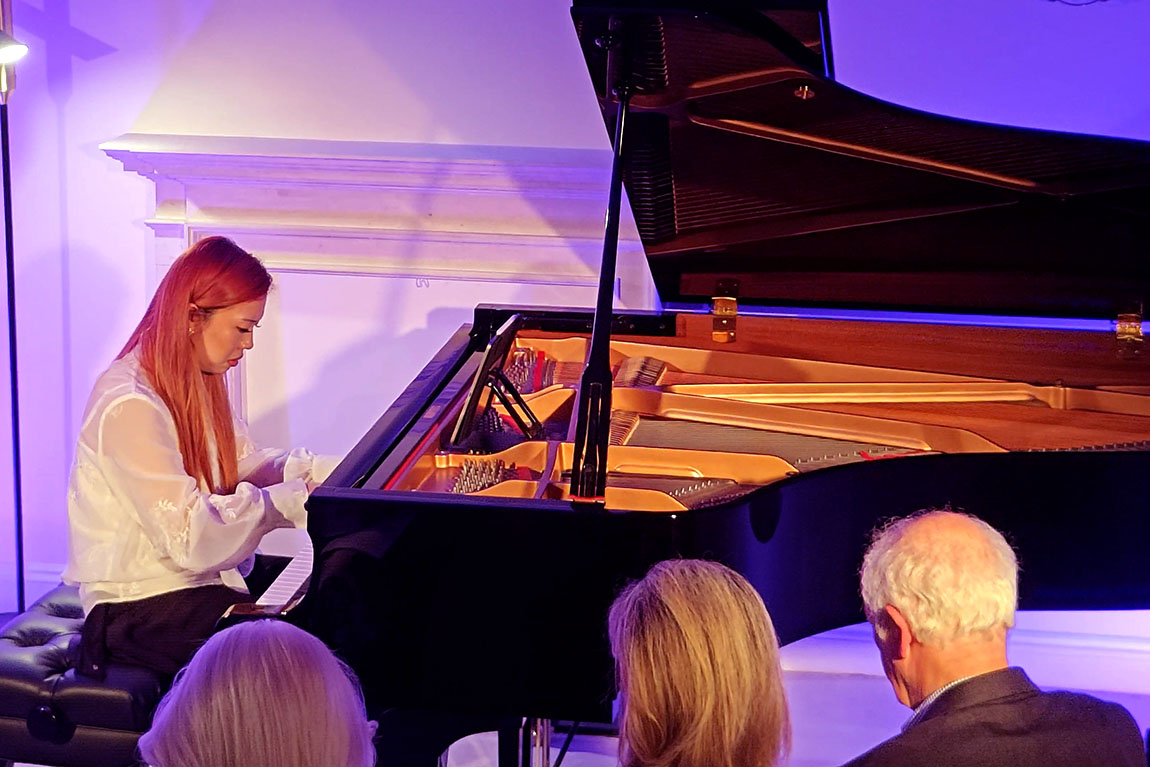

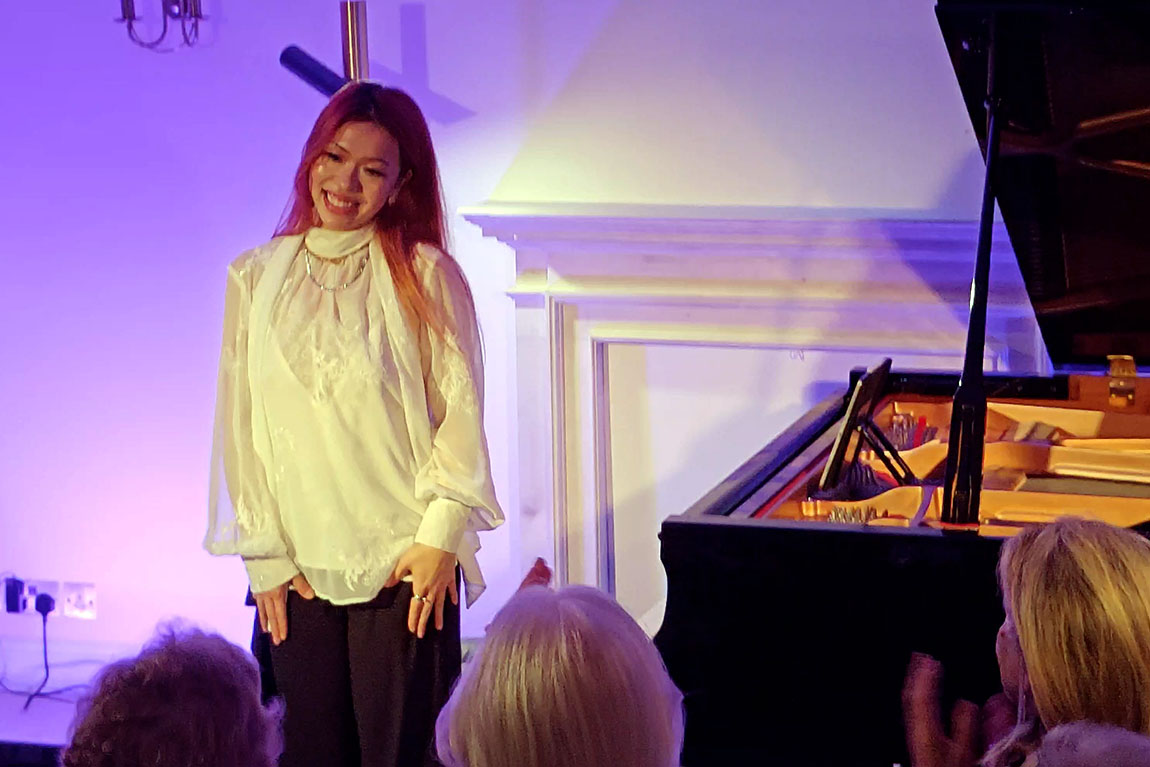
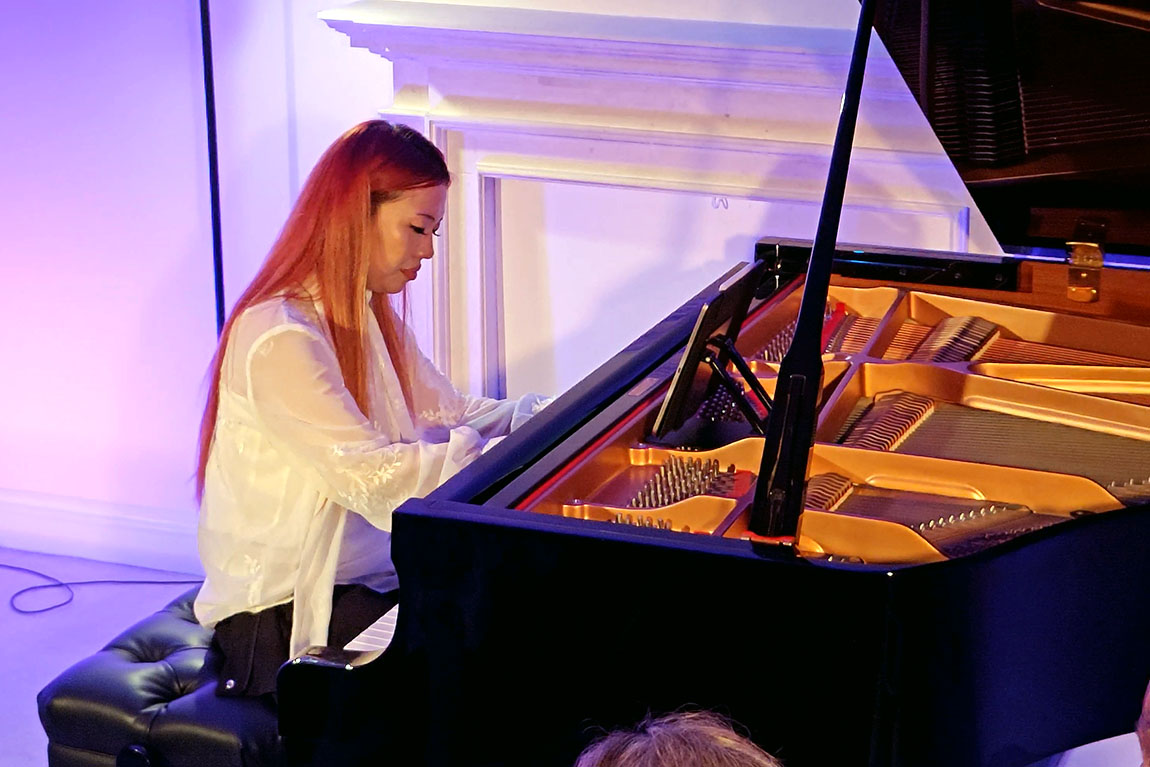
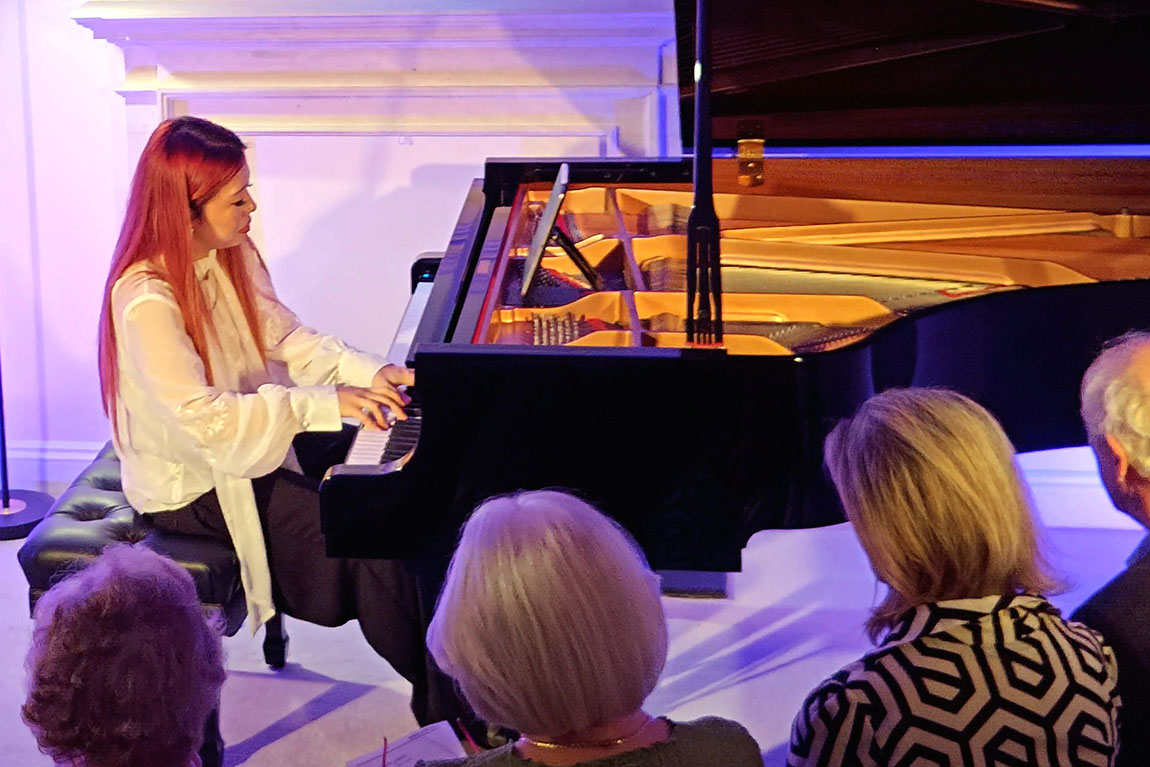
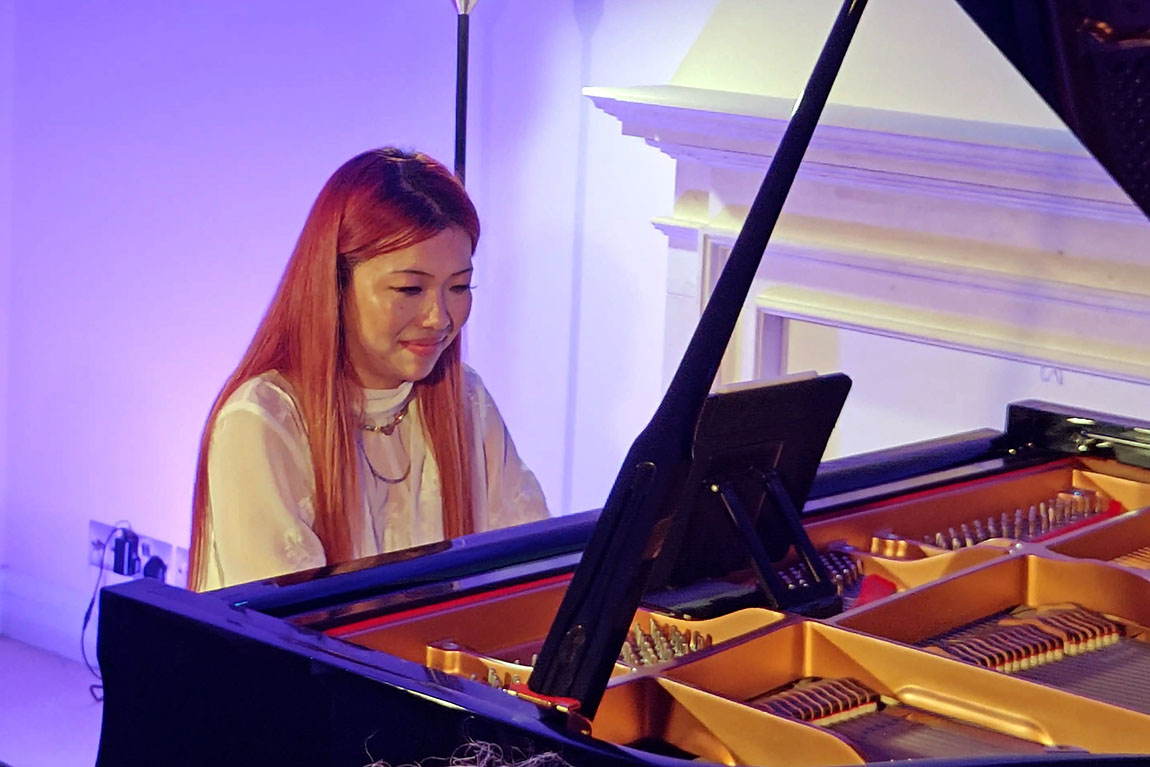
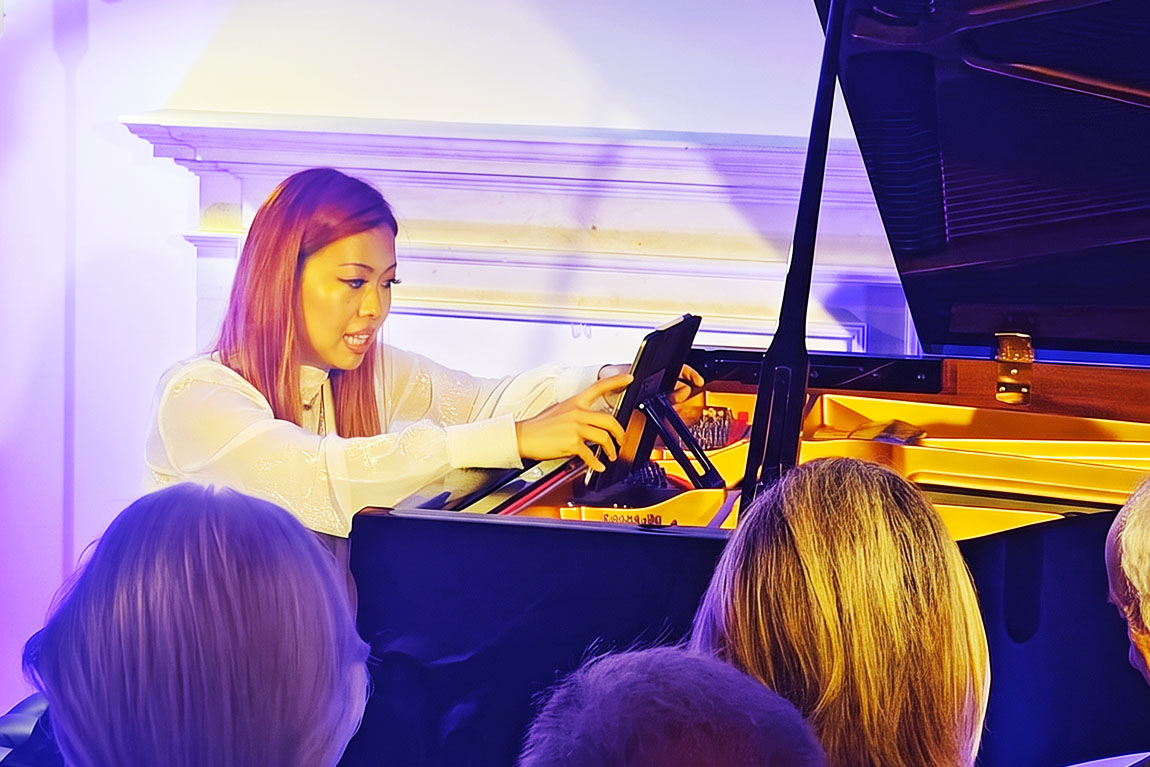
On the celebratory occasion of our 150th recital since we started Breinton Recital Society, we welcomed pianist Junyan Chen, a prize winner of the Leeds International Piano Competition 2024.
First off, Junyan is a born performer. Of course, she is geared with virtuoso technique, extended artistic senses and improvisational instinct, but there is much more to her. Her infectious personality, borderless curiosity, undisturbed challenging spirit, bold vision, outpouring of enthusiasm and unlimited willingness to connect to the audience places her in a league of her own. What an exciting evening it was!
Junyan is determined to build her own brand. She loves to work with living composers and musicians of different genres. She loves the challenge of learning new pieces. Her programme this evening traced a poetic evolution of folk tradition through four distinct voices by four different composers – Chick Corea, Amy Beach, Unsuk Chin and Johannes Brahms. It juxtaposed distinct musical styles, mixing classical ‘beefy’ (her word!) repertoire with jazz-influenced and rhythmic modern compositions.
Junyan walked us through the miniature songs by Chick Corea that brought wandering and reminiscing sensations. Amy Beach’s magnificent Variations on Balkan Themes was an earth-shuttering experience. The intimate theme was played so sorrowfully then Junyan rolled out the great virtuoso variations that followed with momentum and gusto. It had an orchestral ambience and feeling of tenderness, nostalgia, passion, grief and agitation; a beautiful experience.
With Unsuk Chin’s Etudes, Junyan took us to a totally different sound world. She told us that she challenged herself to learn them, and that these were the type of pieces which get lost on your fingers if you miss playing even a day. Sure enough, the programme notes describe them as “the most admired and most feared items in the modern piano repertoire”!
Brahm’s Sonata No. 2 was simply thrilling. It was big, dramatic, and with her masterful technical command and deep emotional engagement, it had a convincing immediacy with astonishing precision and sound creation until the mysteriously abrupt ending.
One thing so noticeable to me throughout Junyan’s performance was that, be it mannish fortissimo or gentlest whisper, there was not a single empty sound; every note had its own weight and life. With her vibrant stage presence, it made me think that she was portraying herself through music.
The audience did not let her go until she gave us three encores! The Man I Love by Gershwin, Paraphrase of Moonlight by Millicent McFall, and I’ve Got the Rhythm by Gershwin. Junyan style, through and through.
Junyan Chen made her debut with the Philharmonia Orchestra this season performing Rachmaninov’s Piano Concerto No 4. She played this concerto in the final of the Leeds International Piano Competition 2024, where she won Second Prize as well as the chamber music prize and award for a work by a woman composer. In Leeds she collaborated with the Royal Liverpool Philharmonic and Domingo Hindoyan; having previously performed the work with Edward Gardner and the Royal Academy of Music Symphony Orchestra.
Highlights of the 2025/26 season include solo recital debuts in Hamburg, Düsseldorf, Hannover, Fribourg, and at the Klavier-Festival Ruhr, as well as a return to Wigmore Hall in London. She is the Artistic Director of the Leeds International Chamber Series 2025/26. She will perform herself in two of the concerts; a duo with Alim Beisembayev and as a member of the quartet Ensemble Jackalope (whom are Britten Pears Young Artists this season).
In 2025 Junyan performed Sur Incises in a London concert celebrating the centenary of Pierre Boulez, conducted by Susanna Mälkki. As an enthusiastic performer of contemporary music, she regularly collaborates with Manchester Collective and Her Ensemble, recent performances including London’s Southbank Centre and Milton Court Concert Hall. Junyan has worked closely with composers including Hans Abrahamsen (performing his Piano Concerto at the Royal Academy of Music), Mark Anthony-Turnage and Dominic Muldowney.
Her debut solo album, It's Time (Linn Records, 2022), features works by Fazıl Say, Unsuk Chin, Sofia Gubaidulina, and Eleanor Alberga. The disc explores cultural identity through a diverse range of musical genres and art forms.
Following her time at the Shanghai Conservatoire, Junyan moved to London and continued her studies at the Royal Academy of Music, with Professor Joanna MacGregor. She recently held a fellowship at RAM, following her undergraduate and postgraduate studies.
Corea: Children’s Songs
Composed across the 1970s and gathered into a single collection released in 1983, these twenty short pieces are among the most personal music Chick Corea ever put on paper. He wrote them, in his own words, to capture simplicity as a kind of beauty: the way a child sees and hears before the world complicates things.
The model, somewhat unexpectedly for a jazz musician, was Bartók: like the Hungarian composer’s own collections of teaching pieces, each of Corea’s miniatures explores a single idea and leans on the bent, modal colours of folk melody rather than jazz’s usual harmony. There is little virtuosity on display and no improvising; the writing is spare, often only a few lines on the page, and much of its charm lies in the space left around each phrase.
Corea recorded the set for the German label ECM, paired on the same album with a suite of free improvisations, as if to place the composed and the spontaneous side by side and let the listener hear both ends of his musical personality at once.
The ten pieces heard this evening move between his more wistful, wandering songs and moments of real rhythmic delight, pieces over almost as soon as they begin that ask the ear to slow down rather than speed up.
Beach: Variations on Balkan Themes
Amy Beach heard these melodies before she had any thought of using them. At a lecture given in Boston by a missionary couple who had spent years living among Balkan communities, she listened to a handful of folk songs they had collected, including tunes whose titles translate as “O My Mother” and “The Old Mountain”, and, by her own account, memorised four of them on the spot. The region they came from was, at that moment, gripped by unrest, and Beach later wrote that something of that turbulence found its way into the music. They resurfaced years afterwards in this set of variations, her longest and most demanding work for solo piano, and one that shows a very different side of a composer usually associated with the intimacy of song.
Beach had been a prodigy at the keyboard as a child, and might easily have built a career as a touring virtuoso; instead, on her marriage in 1885 to the Boston surgeon Henry Harris Aubrey Beach, she largely gave up public performing at her husband’s wish and turned her attention to composition, teaching herself the craft with the same discipline she had once brought to the piano. The result, over the following two decades, was a body of large-scale concert music unmatched at the time by any other American woman: songs, chamber works, a symphony, a piano concerto. This set of variations belongs to the second half of that period, when her ambition for the concert stage had grown to match her technique; few of her other works find Beach placing herself in such direct company with the great virtuoso variation sets of the nineteenth century, only building hers from a folk melody that was never hers to begin with, rather than a theme of her own invention.
The theme itself is plaintive, sung low in the piano’s register, in the minor key of the original folk tune. What Beach does with it afterwards is closer to orchestral thinking than to keyboard variation as usually practised: one variation glitters and dances, another turns dark and stormy, another slows almost to a barcarolle’s gentle rocking, as if the melody were being remembered rather than played. By the work’s close the tune has been carried through moods it could never have suggested on its own, through tenderness, agitation, even something like grief, before a final variation gathers everything back toward its original, simple shape.
Chin: Etudes No. 1 and No. 6
Trained first in Seoul and then, more decisively, in Hamburg under György Ligeti, one of the twentieth century’s most inventive composers for the piano, Chin was pushed by her teacher, by her own account, to find a voice entirely her own rather than his. Her six studies for piano, composed between 1995 and 2003, sit in the old tradition of the concert etude that runs from Chopin through Debussy and Ligeti himself, each one setting itself a single problem of sound or motion and following it to an extreme.
The first study, written out of sequence in 1999, builds an entire, shimmering world out of the overtones that ring quietly inside a single low note, patiently multiplying until the air itself seems to vibrate. A second layer of colour comes from somewhere further afield: a journey to Bali the previous year had introduced Chin to the intricate, subtly tuned world of gamelan music, and something of that shimmer, the sense of many small bright sounds slightly out of alignment with one another, works its way into the study’s own sound world.
The other study heard this evening was written some years later, as a birthday tribute for the composer and conductor Pierre Boulez on his seventy-fifth. Its starting point came not from the concert hall but from the electronic studio, where Chin had worked with the tiny digital sound particles, each only a few dozen milliseconds long, that engineers call “grains.” Rather than simply describing the effect in musical terms, she set out to recreate it directly at the keyboard: piano writing that barely sounds like piano writing at all, closer to the texture of a swarm or a fine spray than to melody or harmony as usually understood.
What unites the two studies, heard side by side, is less a sound than an attitude: a fascination with sound as raw material, endlessly divisible and endlessly renewable, closer to the world of electronic music than to the piano’s own Romantic past. Chin has lived in Berlin since the late 1980s and is now among the most performed living composers anywhere, honoured with the Grawemeyer Award, the Arnold Schoenberg Prize and the Wihuri Sibelius Prize among others; her works are commissioned and championed by the world’s leading orchestras and soloists, and these two studies remain among the most admired and most feared items in the modern piano repertoire, taken up by pianists as a direct test of nerve and imagination.
Brahms: Piano Sonata No. 2
Brahms was not yet twenty when he wrote this sonata in Hamburg during the summer of 1852, with an ambition that still shows in every bar. He had grown up in modest circumstances there, the son of a working musician who scraped a living playing double bass in the city’s dance halls and taverns, and had earned money himself as a boy at the keyboard in similar rooms before any of Europe’s concert halls had heard his name. This sonata was, in fact, composed before the sonata that would be published as his first; Brahms simply judged the other work stronger and held this one back, a rare moment of the young composer second-guessing his own instincts.
What changed everything was a journey to Düsseldorf the following autumn. Brahms arrived, largely unknown outside a small circle, with a letter of introduction from the violinist Joseph Joachim, and played through his own music for Robert and Clara Schumann. Robert’s private verdict, jotted in his diary that evening, was blunt: “a visit from Brahms (a genius).”
Within weeks Schumann had gone into print with an essay proclaiming the young Hamburger the coming man of German music, praise so sudden and so total that Brahms would spend much of the rest of his career living up to it. When this sonata reached publication soon afterwards, it carried a dedication to Clara Schumann, made, Brahms admitted, with real trepidation. It was the beginning of a friendship that would last more than forty years, until her death in 1896, only months before his own.
The sonata’s opening is big and dramatic, full of the technical display of a young man determined to be taken seriously, writing that reaches for the scale and weight of an orchestra rather than the more intimate world composers usually chose for a keyboard debut. It is the slow movement that reveals something gentler underneath the ambition. Brahms builds it as a set of variations on an old German love-song, a melody of loss and longing far older than he was, and lets it darken and brighten in turn before settling, unexpectedly, into major-key warmth. The following movement, a scherzo, seems at first to strike out in a new direction, until its opening idea turns out to be the slow movement’s theme in disguise, the same melody wearing a sharper, more urgent rhythm.
That kind of quiet cross-reference, one idea returning transformed rather than simply repeated, runs through the whole sonata, and points toward the composer Brahms would spend the rest of his career becoming.
The finale opens gently, almost tentatively, before breaking into a large, turbulent movement built on a grand scale, Brahms reaching, not always smoothly, for the drama and sweep of Beethoven. Only right at the close does the music remember where it began: the opening’s quiet phrases return, hushed almost to nothing, closing an evening’s journey from folk memory to full-scale drama exactly where this programme’s own arc promised it would end.